template<typename TChar>
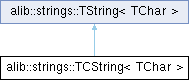
class alib::strings::TCString< TChar >
This class specializes its base class String in that respect that the character strings represented are guaranteed to be zero-terminated.
Zero-terminated strings are widely used by programming language C and are often called "C-strings", what gave the class its name.
- See also
- For an introduction into the ALib string classes see this module's Programmer's Manual.
- Template Parameters
-
Definition at line 30 of file cstring.inl.
|
|
constexpr | TCString ()=default |
| | Defaulted default constructor. Leaves this instance uninitialized and undefined.
|
| constexpr | TCString (const TChar *pBuffer, integer contentLength) |
| constexpr | TCString (lang::IsNullptr auto const &) noexcept |
| | Constructor accepting nullptr. Constructs a nulled string.
|
| template<typename T> |
| constexpr | TCString (T src) |
| template<typename TAllocator> |
| | TCString (TAllocator &allocator, const TString< TChar > ©) |
| template<typename TAllocator> |
| void | Allocate (TAllocator &allocator, const TString< TChar > ©) |
| template<typename TAllocator> |
| void | Free (TAllocator &allocator) const |
| template<lang::Inclusion TInclusion, typename TCheck = CHK> |
| integer | IndexOfAny (const TCString &needles, integer startIdx=0) const |
| template<typename T> |
| constexpr | operator T () const |
| TChar | operator[] (integer op) const |
| constexpr | TString () noexcept=default |
| template<typename T> |
| constexpr | TString (const T &src) noexcept |
| constexpr | TString (const TChar *pBuffer, integer pLength) noexcept |
|
constexpr | TString (const TString &) noexcept=default |
| | Defaulted copy constructor.
|
| | TString (const_iterator &start, const_iterator &end) |
| constexpr | TString (lang::IsNullptr auto const &) noexcept |
| | Constructor accepting nullptr. Constructs a nulled string.
|
| template<typename T> |
| constexpr | TString (T &src) noexcept |
| template<typename TAllocator> |
| | TString (TAllocator &allocator, const TString< TChar > ©) |
|
constexpr | TString (TString &&) noexcept=default |
| | Defaulted move constructor.
|
| bool | AdjustRegion (integer ®ionStart, integer ®ionLength) const |
| template<typename TAllocator> |
| void | Allocate (TAllocator &allocator, const TString< TChar > ©) |
| const_iterator | begin () const |
| constexpr const TChar * | Buffer () const |
| const_iterator | cbegin () const |
| const_iterator | cend () const |
| template<typename TCheck = CHK> |
| TChar | CharAt (integer idx) const |
| template<typename TCheck = CHK> |
| TChar | CharAtEnd () const |
| template<typename TCheck = CHK> |
| TChar | CharAtStart () const |
| template<typename TCheck = CHK, lang::Case TSensitivity = lang::Case::Sensitive> |
| int | CompareTo (const TString &rhs, integer rhsRegionStart, integer rhsRegionLength, integer regionStart, integer regionLength=MAX_LEN) const |
| template<typename TCheck = CHK, lang::Case TSensitivity = lang::Case::Sensitive> |
| int | CompareTo (const TString &rhs, integer rhsRegionStart, integer rhsRegionLength=MAX_LEN) const |
| template<typename TCheck = CHK, lang::Case TSensitivity = lang::Case::Sensitive> |
| int | CompareTo (const TString< TChar > &rhs) const |
| template<typename TCheck = CHK, lang::Case TSensitivity = lang::Case::Sensitive> |
| bool | ContainsAt (const TString &needle, integer pos) const |
| integer | CopyTo (TChar *dest) const |
| template<typename TCheck = CHK, lang::Case TSensitivity = lang::Case::Sensitive> |
| integer | Count (const TString &needle, const TString &omit, integer startPos=0) const |
| template<typename TCheck = CHK, lang::Case TSensitivity = lang::Case::Sensitive> |
| integer | Count (const TString &needle, integer startPos=0) const |
| template<typename TCheck = CHK> |
| integer | CountChar (TChar needle, integer startPos=0) const |
| template<typename TCheck = CHK> |
| integer | CountChar (TChar needle, TChar omit, integer startPos) const |
| const_reverse_iterator | crbegin () const |
| const_reverse_iterator | crend () const |
| const_iterator | end () const |
| template<typename TCheck = CHK, lang::Case TSensitivity = lang::Case::Sensitive> |
| bool | EndsWith (const TString &needle) const |
| template<typename TCheck = CHK, lang::Case TSensitivity = lang::Case::Sensitive> |
| bool | Equals (const TString< TChar > &rhs) const |
| template<typename TAllocator> |
| void | Free (TAllocator &allocator) |
| std::size_t | Hashcode () const |
| std::size_t | HashcodeIgnoreCase () const |
| template<typename TCheck = CHK, lang::Case TSensitivity = lang::Case::Sensitive> |
| integer | IndexOf (const TString &needle, integer startIdx=0, integer endIdx=strings::MAX_LEN) const |
| template<typename TCheck = CHK> |
| integer | IndexOf (TChar needle, integer regionStart, integer regionLength) const |
| template<typename TCheck = CHK> |
| integer | IndexOf (TChar needle, integer startIdx=0) const |
| template<lang::Inclusion TInclusion, typename TCheck = CHK> |
| integer | IndexOfAny (const TString &needles, integer startIdx=0) const |
| template<typename TCheck = CHK> |
| integer | IndexOfFirstDifference (const TString &needle, lang::Case sensitivity=lang::Case::Sensitive, integer startIdx=0) const |
| integer | IndexOfOrLength (TChar needle) const |
| template<typename TCheck = CHK> |
| integer | IndexOfOrLength (TChar needle, integer startIdx) const |
| integer | IndexOfSegmentEnd (TChar opener, TChar closer, integer idx) const |
| constexpr bool | IsEmpty () const |
| constexpr bool | IsNotEmpty () const |
| constexpr bool | IsNotNull () const |
| constexpr bool | IsNull () const |
| template<typename TCheck = CHK> |
| integer | LastIndexOf (TChar needle, integer startIndex=MAX_LEN) const |
| template<lang::Inclusion TInclusion, typename TCheck = CHK> |
| integer | LastIndexOfAny (const TString &needles, integer startIdx=MAX_LEN) const |
| constexpr integer | Length () const |
| template<typename T> |
| constexpr | operator T () const |
| constexpr TString & | operator= (const TString &) noexcept=default |
| constexpr TString & | operator= (TString &&) noexcept=default |
| TChar | operator[] (integer idx) const |
| uint64_t | ParseBin (integer *newIdx) const |
| uint64_t | ParseBin (integer startIdx, integer *newIdx) const |
| uint64_t | ParseBin (integer startIdx=0, TNumberFormat< TChar > *numberFormat=nullptr, integer *newIdx=nullptr) const |
| uint64_t | ParseBin (TNumberFormat< TChar > *numberFormat, integer *newIdx=nullptr) const |
| uint64_t | ParseDec (integer *newIdx) const |
| uint64_t | ParseDec (integer startIdx, integer *newIdx) const |
| uint64_t | ParseDec (integer startIdx=0, TNumberFormat< TChar > *numberFormat=nullptr, integer *newIdx=nullptr) const |
| uint64_t | ParseDec (TNumberFormat< TChar > *numberFormat, integer *newIdx=nullptr) const |
| uint64_t | ParseDecDigits (integer startIdx=0, integer *newIdx=nullptr) const |
| double | ParseFloat (integer *newIdx) const |
| double | ParseFloat (integer startIdx, integer *newIdx) const |
| double | ParseFloat (integer startIdx=0, TNumberFormat< TChar > *numberFormat=nullptr, integer *newIdx=nullptr) const |
| double | ParseFloat (TNumberFormat< TChar > *numberFormat, integer *newIdx=nullptr) const |
| uint64_t | ParseHex (integer *newIdx) const |
| uint64_t | ParseHex (integer startIdx, integer *newIdx) const |
| uint64_t | ParseHex (integer startIdx=0, TNumberFormat< TChar > *numberFormat=nullptr, integer *newIdx=nullptr) const |
| uint64_t | ParseHex (TNumberFormat< TChar > *numberFormat, integer *newIdx=nullptr) const |
| int64_t | ParseInt (integer *newIdx) const |
| int64_t | ParseInt (integer startIdx, integer *newIdx) const |
| int64_t | ParseInt (integer startIdx=0, TNumberFormat< TChar > *numberFormat=nullptr, integer *newIdx=nullptr) const |
| int64_t | ParseInt (TNumberFormat< TChar > *numberFormat, integer *newIdx=nullptr) const |
| uint64_t | ParseOct (integer *newIdx) const |
| uint64_t | ParseOct (integer startIdx, integer *newIdx) const |
| uint64_t | ParseOct (integer startIdx=0, TNumberFormat< TChar > *numberFormat=nullptr, integer *newIdx=nullptr) const |
| uint64_t | ParseOct (TNumberFormat< TChar > *numberFormat, integer *newIdx=nullptr) const |
| const_reverse_iterator | rbegin () const |
| const_reverse_iterator | rend () const |
| size_type | size () const |
| template<typename TCheck = CHK, lang::Case TSensitivity = lang::Case::Sensitive> |
| bool | StartsWith (const TString &needle) const |
| template<typename TCheck = CHK> |
| TString< TChar > | Substring (integer regionStart, integer regionLength=MAX_LEN) const |
| integer | WStringLength () const |